


I received the Saramonic Ultra for testing and was honestly quite curious to see how it would perform. As someone who records a lot of desk-based product reviews – mainly keyboards and game controllers – audio quality is just as important as video clarity. I’d been considering a wireless setup for a while to free up some desk space and make my recording workflow faster and cleaner. After using the Saramonic Ultra for about two weeks, I have to say it offers a surprising amount of functionality for its size and price.
Setup and First Impressions
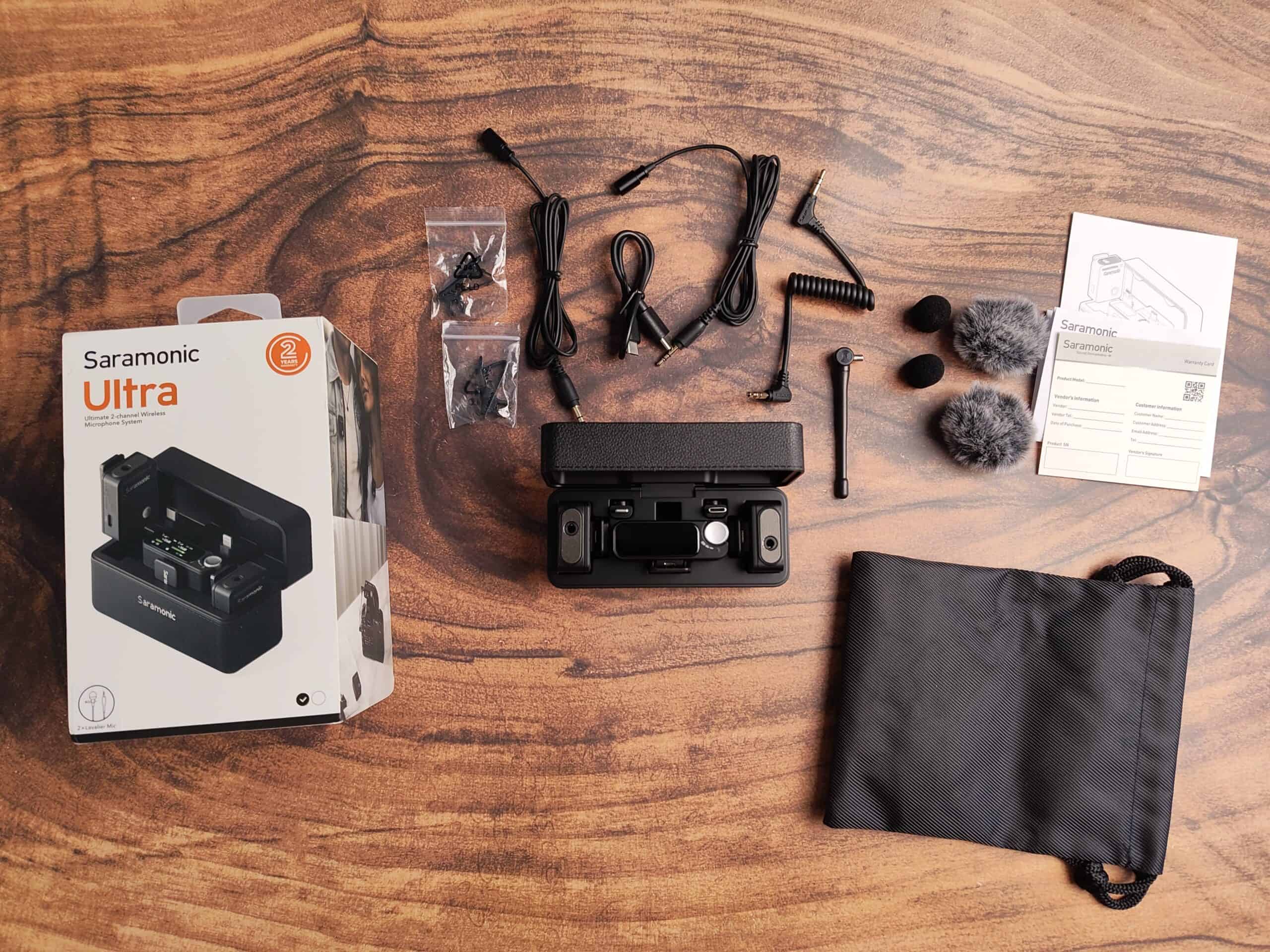
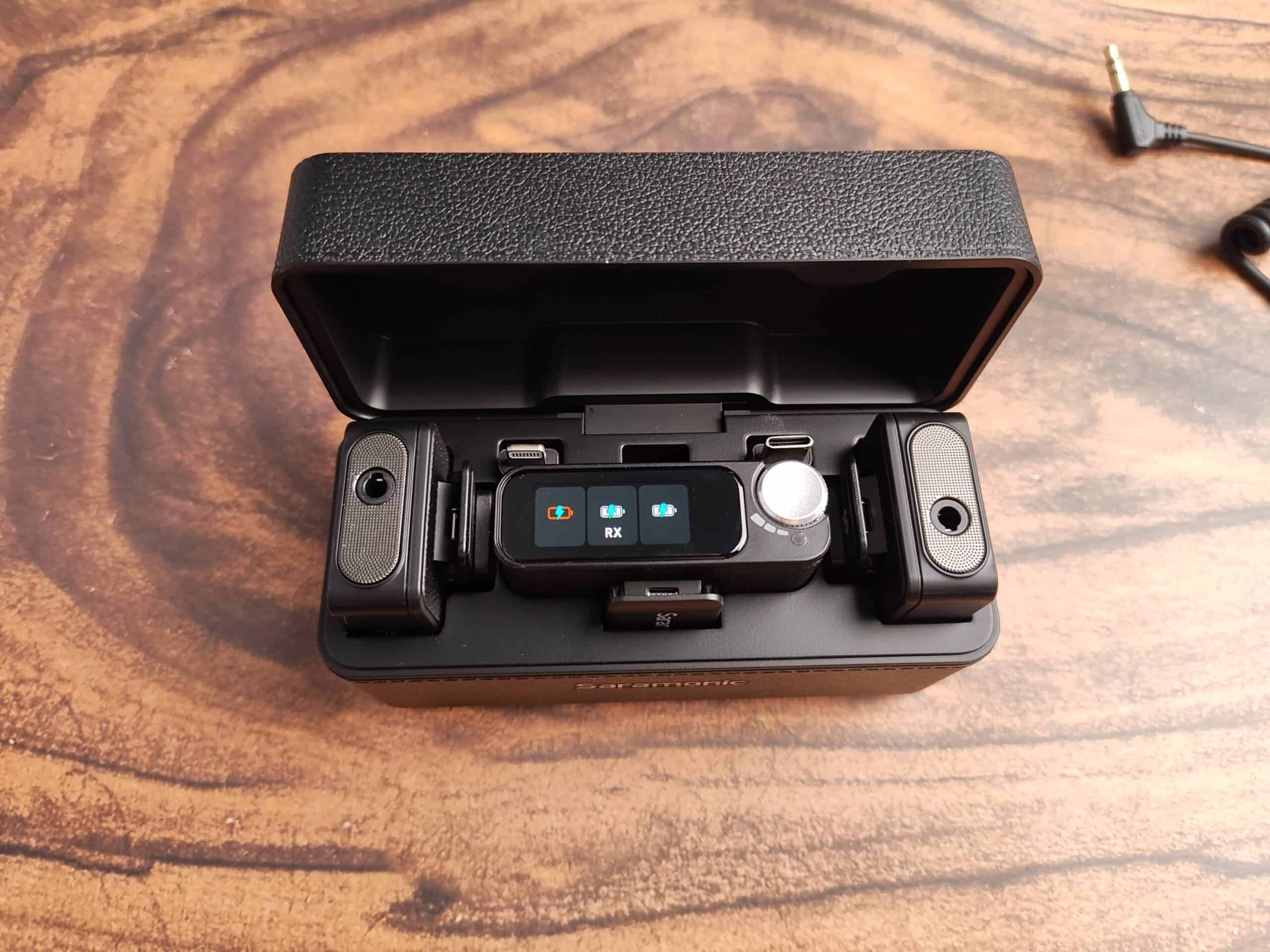
The Saramonic Ultra comes in a compact charging case with two clip-on transmitters and one receiver. You also get USB-C and Lightning adapters for mobile devices, as well as a TRRS cable for cameras. The finish of the set stands out — it has a slightly textured, matte surface that feels more premium than expected. The case itself is easy to carry, lightweight, and looks quite minimal.

Setting the system up was fast. As soon as you open the case, the devices turn on and auto-pair. You just connect the receiver to your phone or camera, clip the transmitter to your shirt, and you are ready to go. There’s no need for a mobile app unless you want remote access to certain features, but even then, all the essentials are available on the device.
I found that the three most useful options for beginners are the Vocal Boost, Low Cut and Low Gain modes. By switching to them you can easily remove any background noise or hissing.
Controls and Interface

The receiver has a small LCD screen and a physical control dial. From here, you can adjust input gain, monitor battery levels, trigger internal recording on the transmitters, and switch between mono, stereo, and safety track modes. Everything is accessible without touching your phone or using an app, which I really appreciated. The screen quite small and you can control it via touchscreen (which can be a bit tricky sometimes, but you can also use the knob).
Audio Quality and Recording Options


In terms of sound quality, the Saramonic Ultra performs really well. I compared it with my wired Rode VideoMic GO II. The differences are subtle,but the Ultra sounds better I think. The built-in microphone sounds clean and clear. The included lavalier mic is usable but slightly more compressed. If you value transparency, I’d recommend sticking with the built-in mic or using your own lav.
Sound test w/ ZV-E10

This whole review of Nuphy Air75 v3 keyboard is recorded using Saramonic Ultra mic + Sony ZV-E10 camera. Most of the time the mic is around 20 cm from my face and for the sound test of the keyboard you can see it visible on the desk from 6:15. It performs really well with that close-up audio recording of the key pressing.
The transmitters support internal 32-bit float recording with 8 GB of built-in memory. That gives you roughly 10 hours of backup audio, which is ideal for preventing clipped or distorted recordings. You also get onboard noise reduction, which helps in outdoor environments. There is a dedicated noise reduction button, though its placement makes it easy to press accidentally.
Range, Battery Life, and Durability

Saramonic claims a range of 250 meters without obstruction, or up to 300 meters with the included external antenna. I tested it in indoor conditions with a few walls in between and never had any signal dropouts. Latency is minimal and didn’t affect syncing during editing.
Battery life is rated at 6 hours per unit, and the charging case provides one full recharge for the entire system. In practice, this was enough for two full days of light shooting. Charging takes about 1.5 hours through USB-C.
Another standout feature is IPX5 water resistance. You should still avoid submerging it, but it should survive light rain or humid outdoor shoots without issue. The transmitters also support up to 130 dB SPL, meaning they can handle very loud environments without distortion — useful for events or noisy locations.
Summary
The receiver only mounts in one direction on a camera shoe, which makes vlogging or selfie-style shooting more difficult unless you use a cable extension. Also, while you do get windshields for the transmitters, there are no accessories included for the lavalier mic. A hard case would have been nice too, as the pouch it comes with offers limited protection.
Still, considering its feature set, build quality, and audio performance, the Saramonic Ultra is a very strong alternative to more expensive sets from DJI and Rode at its $299 price point. Timecode support, 32-bit float recording, water resistance, and strong wireless range make it a solid pick for solo creators and semi-pro setups. As you can see from my review it also works well recording closeups. It may not beat the competition in every category, but it offers more than enough to stand on its own.
Also, you can use our unique coupon code for Saramonic products on their store: code HLPLANET will give you 10% discount off any order.
Saramonic Ultra

Saramonic Ultra Specs
Wireless System
- Technology: Digital 2.4 GHz with 128-bit encryption
- Maximum Operating Range: Up to 300 meters / 984 feet
- Latency: 25 ms
- Number of Transmitters: 2 (clip-on with built-in microphones)
- Built-in Recorder: Yes, on transmitters (internal storage)
- Timecode Support: Yes (for synchronization with video)
Receiver
- Type: Camera-mount
- Audio Outputs:
- 3.5 mm TRRS (unbalanced)
- USB-C and Lightning (with included adapters)
- Display: LCD screen (non-backlit) for settings and monitoring
- Battery: Built-in rechargeable, up to 6 hours runtime
- Charging: USB-C, full charge in 1.5 hours
- Mounting: Shoe-mount with included hardware
- Antenna: Internal PIFA antenna
Transmitters
- Microphone Types: Built-in omnidirectional and lavalier included
- Frequency Response:
- Built-in mic: 20 Hz – 20 kHz
- Lavalier mic: 70 Hz – 16 kHz
- Maximum SPL:
- Built-in mic: 130 dB
- Lavalier: 115 dB
- Input/Output: 3.5 mm TRS mic input on transmitters
- Battery: Built-in rechargeable, up to 6 hours runtime
- Charging: USB-C
- Indicators: Single-LED status indicators
Physical & Environmental
- Water Resistance: IPX5 (splash and rain resistant)
- Dimensions:
- Transmitter: 45.5 x 33.5 x 15 mm
- Receiver: 54 x 34 x 18 mm
- Weight:
- Transmitter: 35 g
- Receiver: 37 g

I love testing and writing about new tech. I focus on keyboards and controllers. I'm also a gamer and an engineer. Check out my Twitter for keyboard and controller news and reviews.


