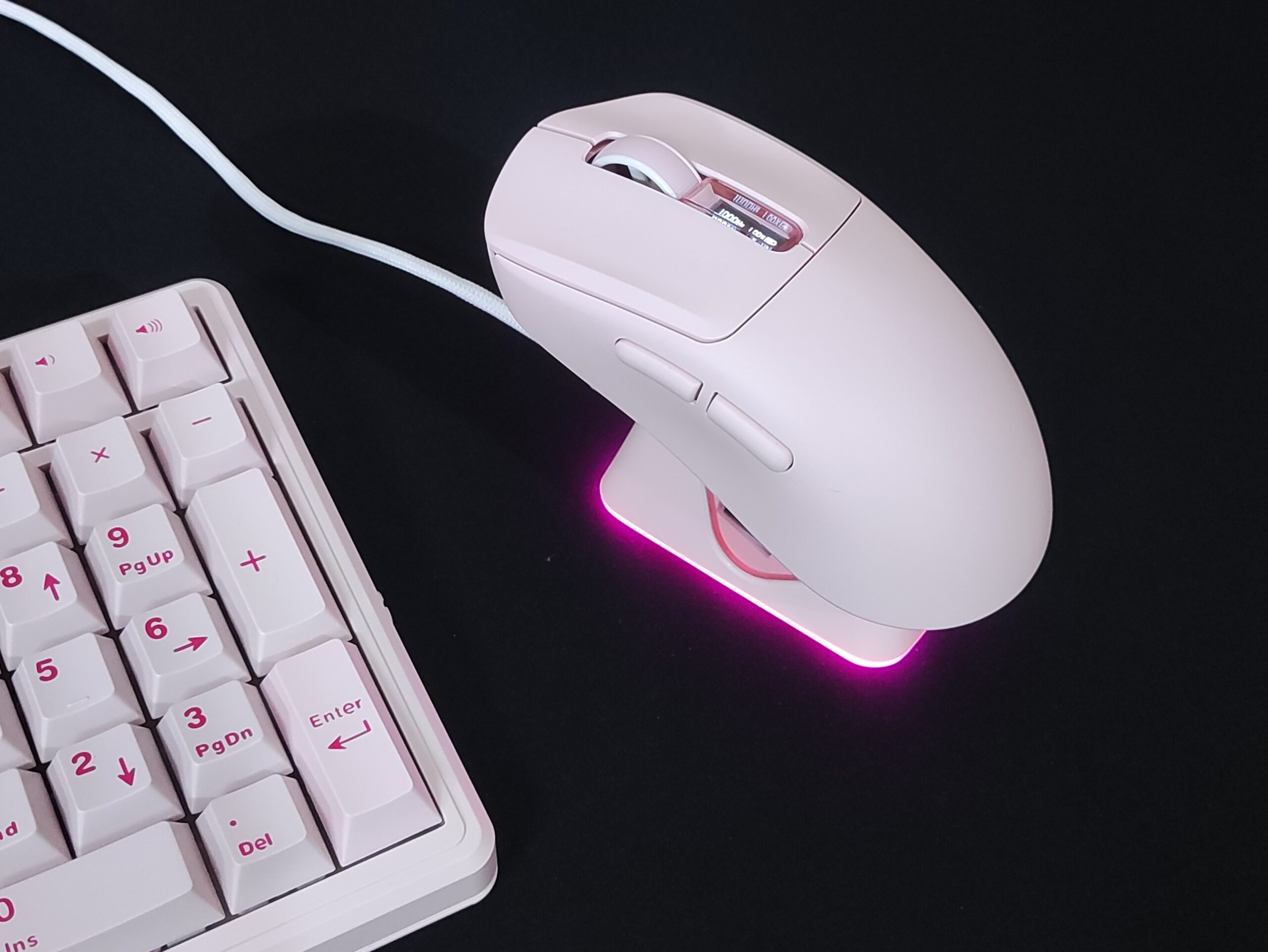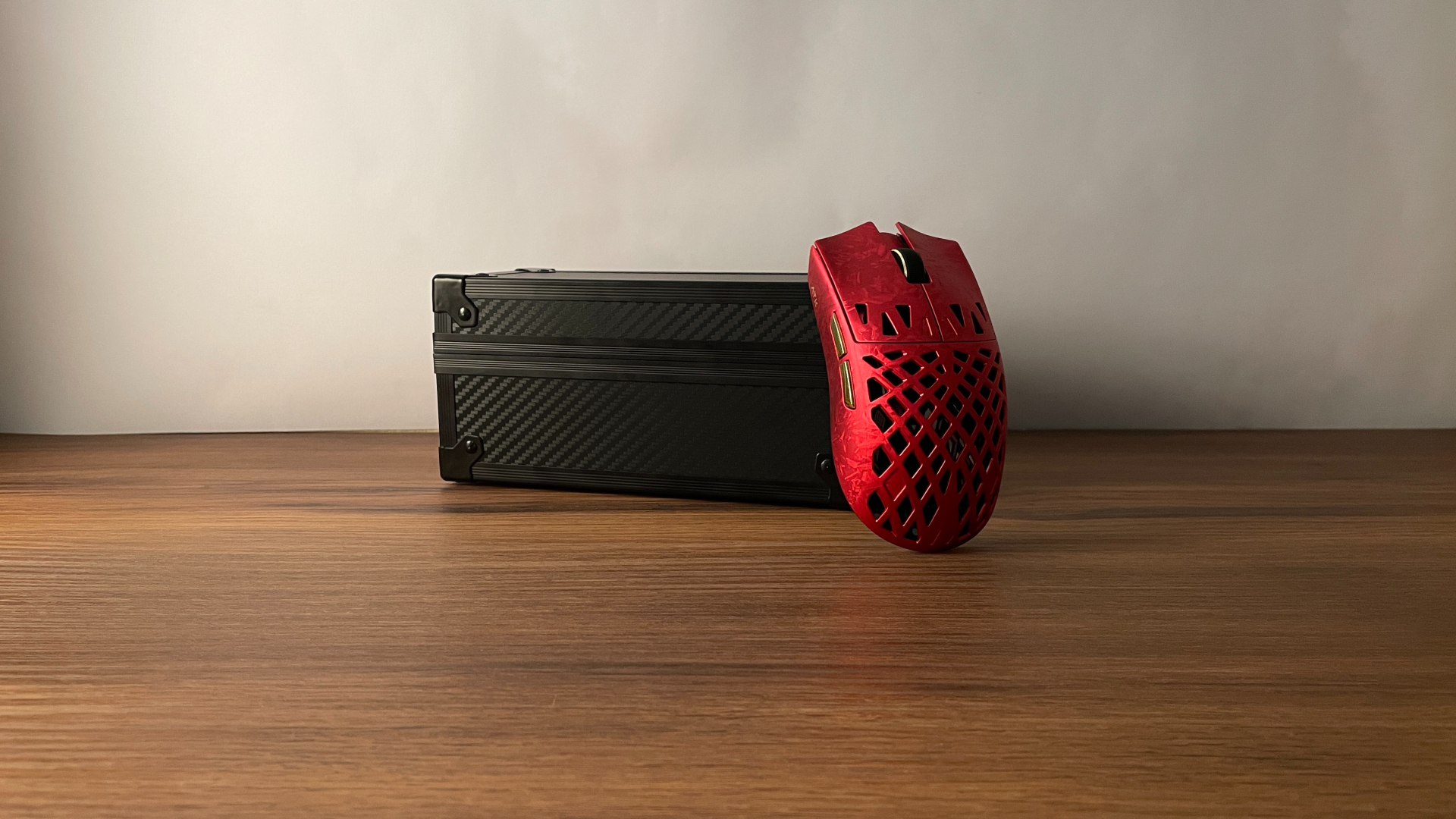
Epomaker continues to expand its lineup of gaming mice. Not long ago, I had a chance to test the Epomaker Carbon X, and it turned out to be a surprisingly solid mouse that left a very positive impression overall. Today, I’m taking a look at another mouse with a very similar naming theme – the Epomaker Carbonis.
What caught my attention right away was that Epomaker didn’t follow the current trend of releasing yet another symmetrical mouse this time. Instead, the Carbonis comes with a pronounced ergonomic shape and even features a small built-in display. It’s an unusual addition, and one that made me curious from the moment I first saw it.
Since I had such a good experience with the Carbon X, I was interested to see whether the Carbonis could deliver the same level of performance. And after spending some time with it as my daily driver, I got a clear understanding of where it performs well and where there is still room for improvement. So let’s get into it.
Unboxing: What’s Inside?

The packaging is neat and compact, with a design that feels modern but not overdone. Sliding the box open, the first thing you see is the mouse itself, carefully tucked into a white protective bag. Underneath, you’ll find the accessories in a white box.

Everything you get:
- Carbonis mouse
- 2.4GHz wireless dongle
- Braided USB Type-C to Type-A cable
- Spare set of skates
- Manual
The first thing I want to point out is the quality of the included braided cable. Epomaker did a solid job here, because it doesn’t just feel like a regular braided cable – it’s much closer to a paracord. It’s lightweight and quite flexible, which makes it very comfortable to use. Even though this is a wireless mouse, it’s still nice to see this level of attention to detail in the included accessories.
The dongle also stands out a bit thanks to its faceted design and semi-transparent plastic shell. Personally, I’m not the biggest fan of transparent finishes in general, but I know a lot of people really like this kind of look. There is also a practical side to it – thanks to the transparent shell, you can actually see that the dongle is built around the Nordic 54L05 chip without opening it up. That’s a top-tier solution right now, so it’s good to see it used not only in the mouse itself but also in the receiver.

On top of that, the package also includes a set of spare skates, which is definitely a nice touch. It might seem like a small addition, but for anyone who uses their mouse intensively, skates wear down over time and can affect the smoothness of movement. Having a replacement set right out of the box means you don’t have to worry about hunting for compatible parts later. It’s a thoughtful gesture from Epomaker, showing that they considered not just the first impression of the product, but also its long‑term usability. For me, that kind of attention to detail always adds extra value to the overall experience.
Feel & Look
The Epomaker Carbonis is made from a carbon fiber composite and features a solid, non-perforated shell. On closer inspection, you can notice a really interesting texture on the surface. Across the shell, there’s a subtle swirl pattern that somewhat reminds me of a Damascus steel pattern. It looks unique and adds a certain character to the mouse. At the same time, this isn’t just about aesthetics – the texture actually improves grip and feels very pleasant to the touch. I even caught myself absent‑mindedly running my finger over the surface because of how unusual it feels. Beyond that, the finish is completely resistant to fingerprints and barely collects any dirt, which makes it practical as well as stylish.

In terms of weight, the Carbonis comes in at 55 grams, which is about 5 grams more than the official spec. However, considering that this is a solid shell design with no perforations and a slightly larger ergonomic shape compared to typical symmetrical mice, 55 grams still feels very reasonable and lightweight in hand.

As for build quality, I have no complaints whatsoever. The carbon composite really does its job – the mouse feels light, yet extremely solid and durable. There is absolutely no side flex or creaking when pressure is applied. There is also no sensor or lens rattle, and even when shaking the mouse, there are no loose parts or any internal noise.
The mouse comes with fairly large PTFE skates on the bottom. There’s one at the front and one at the rear, along with a small ring around the sensor. They provide a very balanced glide for stock skates – not overly fast, but also not scratchy or rough on the surface. The glide feels just right. I really like that they cover a large area, which helps keep the glide stable and consistent, and overall I’m quite satisfied with them.

The mouse is available in two color options – a classic black and a black-to-purple gradient. I personally went with the black-purple colorway because it felt a bit more unique and visually appealing to me. However, if you prefer something more understated and traditional, the black version is definitely the safer choice.
Overall, in terms of design, I would describe the Carbonis as fairly restrained but still distinctive. There are no flashy elements or RGB lighting here. Instead, the scroll wheel features subtle gold accents, and on the left side you’ll also find the Epomaker logo done in the same golden finish. The only slightly unusual element is the built-in display located just below the scroll wheel, but I’ll talk about that in a dedicated section later.

Shape & Ergonomics
The Epomaker Carbonis features a right-handed ergonomic shape and falls into the medium-sized mouse category. The button layout is straightforward: two main clicks, a scroll wheel, and two side buttons. On the underside, you’ll find a mode toggle for switching connections and a dedicated DPI button, which keeps everything simple and accessible.

Overall, the shape will feel very familiar to anyone who has used ergonomic mice before. The hump is positioned centrally along the front‑to‑back axis, but when you look at it from left to right, it’s shifted slightly toward the left side. From there, the body slopes gently to the right, with the shell widening in the lower portion to provide additional palm support. It’s one of those classic ergonomic shapes that’s hard to forget once you’ve tried it because of how naturally comfortable it feels.

One interesting design detail is the small ridges on the lower left side of the shell. They add a bit of visual character to the mouse, but in actual use I never noticed them. Regardless of whether I used a palm, fingertip, or claw grip, my hand simply didn’t come into contact with them in a meaningful way. As a result, I can confidently say they remained completely unobtrusive and had no impact on comfort. At least in my experience.

The Carbonis should work particularly well for users with medium to large hands. As for grip styles, the ergonomic shape naturally encourages a palm grip, where it feels most at home. It also works very well with a fingertip grip. Personally, I have medium-sized hands, and I found both palm and fingertip grips comfortable with this mouse. I also tried using it with a claw grip, which is certainly possible, although I don’t really see much reason to use a claw grip on a mouse with such a comfortable ergonomic shape.

The weight distribution in the Carbonis is done properly. The center of mass is positioned directly above the sensor. This is the correct way to implement weight distribution, as it helps maintain optimal tracking and reduces rotational drift during fast movements. This area roughly corresponds to where your thumb naturally rests – below and roughly centered between the forward and back buttons. This placement also makes sense from an ergonomics standpoint, since lateral mouse movements are primarily controlled by the thumb and ring finger. Having the center of mass positioned between these two contact points helps the mouse feel balanced in hand and prevents it from feeling either front-heavy or rear-heavy.

Buttons & Wheel
The main buttons are implemented quite well. There’s a small amount of pre‑travel and post‑travel, but nothing excessive – it’s well within the normal range and doesn’t affect usability. There is no side travel at all.

Epomaker does not specify which main switches are used in this mouse. After disassembling it, I was surprised to find optical switches from Raesha – the Blue Shell Blue Dot variant. I couldn’t really find any information about these switches online, not even on Raesha’s official website. They look almost identical to the newer Raesha Purple switches, just with a blue housing. I think it’s possible that these are some kind of custom-made switches developed specifically for Epomaker.
What I can say is that they feel genuinely great in use. First of all, there is no metallic ping at all. The click sound is not overly loud and stays quite controlled. They actually sound very similar to standard mechanical switches, so until I opened the mouse, I had no idea these were optical switches. The clicks feel fast and satisfying, with a well-balanced actuation force – not too light, but not heavy either. I would describe them as nicely balanced overall. And of course, they carry the key advantage of optical switches – no risk of developing double-clicking issues over time.
The side buttons are also implemented very well. They are positioned comfortably, and I never had to stretch my finger to reach them. Pre-travel is minimal to the point where it is practically unnoticeable in actual use, and post-travel is virtually non-existent. The buttons feel solid with no wobble or looseness. Inside, Epomaker uses mechanical microswitches from TTC – specifically the Brown Shell Blue Dot variant. Overall, these are solid microswitches. The actuation force sits in the medium range, and the clicks feel pleasant and quite direct, with no mushiness, which you sometimes get with side buttons. The clicks are also not overly loud, so they never feel distracting. Overall, they deliver a satisfying and reliable experience that complements the main clicks perfectly.

As for the scroll wheel, it is rubberized for better grip and more comfortable use. It also features gold accents on the sides, which add a nice visual touch. When disassembling the mouse, I found another pleasant surprise – it uses one of the best encoders currently available – a TTC Gold (dustproof variant). As expected from this encoder, the feel is excellent: scrolling is smooth, the steps are crisp and tactile, yet not overly heavy. There are also no squeaks or any unwanted noises during scrolling. The wheel click is equally pleasant and distinct, requiring a medium, perhaps slightly above-medium, actuation force.

The dustproof construction is actually a big deal. Encoders are mechanical components, and over time dust or small particles can get inside, leading to degraded performance – squeaks, uneven scrolling, or even skipped steps. By using the dustproof variant, Epomaker ensures that the wheel maintains its smoothness and crisp tactile feedback over time. It’s essentially a durability upgrade that makes the mouse more reliable in the long run.
Connectivity & Battery
The Epomaker Carbonis supports tri-mode connectivity, including wired, 2.4GHz wireless, and Bluetooth. This gives a good level of flexibility depending on the use case – whether you want maximum performance or simple wireless convenience for mobile use.
Both the wired and 2.4GHz modes support an 8000Hz polling rate. During testing, the mouse consistently maintained the advertised polling rate without noticeable drops or instability.

Overall, I didn’t experience any issues with connectivity quality. The signal remained strong and stable throughout use, exactly as you would expect from a proper gaming mouse.
One detail worth noting is the design of the wireless dongle. Unlike the typical “USB stick style” dongle that plugs directly into a USB port, the Carbonis uses a dongle that connects via cable. This has become standard practice for high-performance gaming mice. This allows you to position the dongle closer to the mouse, improving signal stability and potentially reducing latency. It also helps reduce interference from other wireless devices nearby.
The mouse is equipped with a 300 mAh battery. In terms of battery life, it is a bit on the short side, averaging around 3–4 days of use at 2 kHz with the display set to auto-off. However, on the positive side, the mouse supports fast charging and is capable of going from 0 to 100% in about an hour.
Since I never fully drained it to zero and usually put it on charge when it dropped to around 15–20%, the charging process in my case was even quicker. This makes the Carbonis practical for daily use, as you can easily top it up during short breaks without worrying about long charging sessions.
Software
The Epomaker Carbonis uses a web driver, which means there’s no need to install additional software on your PC, which is a very convenient feature. The driver recognizes the mouse in both wired mode and 2.4 GHz wireless mode, so setup is seamless regardless of how you’re using it.
The web-based driver is organized into three tabs where you can find all the essential settings. It’s also worth noting that the mouse supports keyboard key remapping, which adds an extra layer of flexibility for customization.
On the screenshots below, you can see all the available settings.


Built-In Screen
We’ve now reached the most interesting part of the mouse – the built-in display. The first thing I want to highlight is how well it has been integrated into the design. Unlike some other mice with displays, where the screen is always visible and impossible to hide, the Carbonis blends it seamlessly into the shell. When the display is turned off, it becomes completely invisible. That’s exactly what sold me on it. The mouse looks stylish, while the built-in display remains subtle and never feels intrusive.

As for the display itself, it is colorful and bright enough to remain easy to read. This is important because some mice with built-in displays use monochrome screens with limited brightness, which makes them difficult to read. Thankfully, that is not the case here.
Power management has also been implemented thoughtfully. By default, the display automatically turns off whenever the mouse is active and registering movement. This helps save battery and makes perfect sense, considering the screen is covered by your hand most of the time anyway. Once the mouse stops detecting movement – for example, when you lift it off the surface – the display turns on after about three seconds and presents an information dashboard.
The dashboard displays:
- DPI
- Polling rate
- Exact battery percentage
- Active connection mode
After roughly ten seconds, the dashboard switches to a slideshow of built-in images. Unfortunately, there is currently no option to upload custom images or personalize the display content.

If you prefer, the display can also be configured to remain active at all times until the mouse enters sleep mode. Naturally, this will have an impact on battery life.
Personally, the feature I appreciate the most is being able to check the exact battery percentage without opening the software. It is a small convenience, but one that I found surprisingly useful.
The display also brings more functionality than just the information dashboard. Thanks to the screen and a set of built-in button shortcuts, you can adjust DPI and polling rate directly on the mouse. And I don’t mean simply switching between pre-configured presets – you can actually modify these settings and save them directly to the mouse’s onboard memory without needing to open the software.
Performance
The PixArt PAW3950 sensor, paired with the Nordic 54L15 MCU inside the mouse and the Nordic 54L05 MCU inside the receiver, delivers exactly what this hardware combination promises – fast,responsive tracking with minimal latency.
In practice, the Carbonis feels every bit like a modern flagship gaming mouse. Tracking is precise and consistent, with no noticeable issues during fast flicks, micro-adjustments, or rapid direction changes. Sensor performance remained flawless in use, and I never encountered any tracking anomalies, spinouts, or unexpected behavior.
The stable 8000Hz polling rate further improves overall responsiveness, especially in fast-paced scenarios. Combined with its low weight and well-balanced shape, the Carbonis feels fast, predictable, and easy to control. At this point, the internal hardware is more than capable of keeping up with even the most demanding competitive gaming scenarios, and the Carbonis makes full use of it.

Pros & Cons
Final Verdict

The Epomaker Carbonis left a positive impression on me. It combines a lightweight yet solid carbon fiber composite shell, a comfortable ergonomic shape, high-end hardware, stable 8000Hz performance, and a useful built-in display that adds a unique touch to the mouse. I also appreciate the attention to detail, from the excellent surface texture to the surprisingly good choice of switches and encoder.
Overall, the Carbonis is a well-executed ergonomic gaming mouse that manages to stand out from the crowd while still getting the fundamentals right, and that’s not something every gaming mouse can claim. If the relatively short battery life isn’t a dealbreaker for you (and the fast charging certainly helps offset that limitation), the Carbonis is an easy mouse to like.
Additional products featured in this review: Epomaker Mix Pro cable in Gradient Purple colorway

Controller and mechanical keyboard enthusiast. Tech reviewer, regularly sharing thoughts about gadgets and computer peripherals.