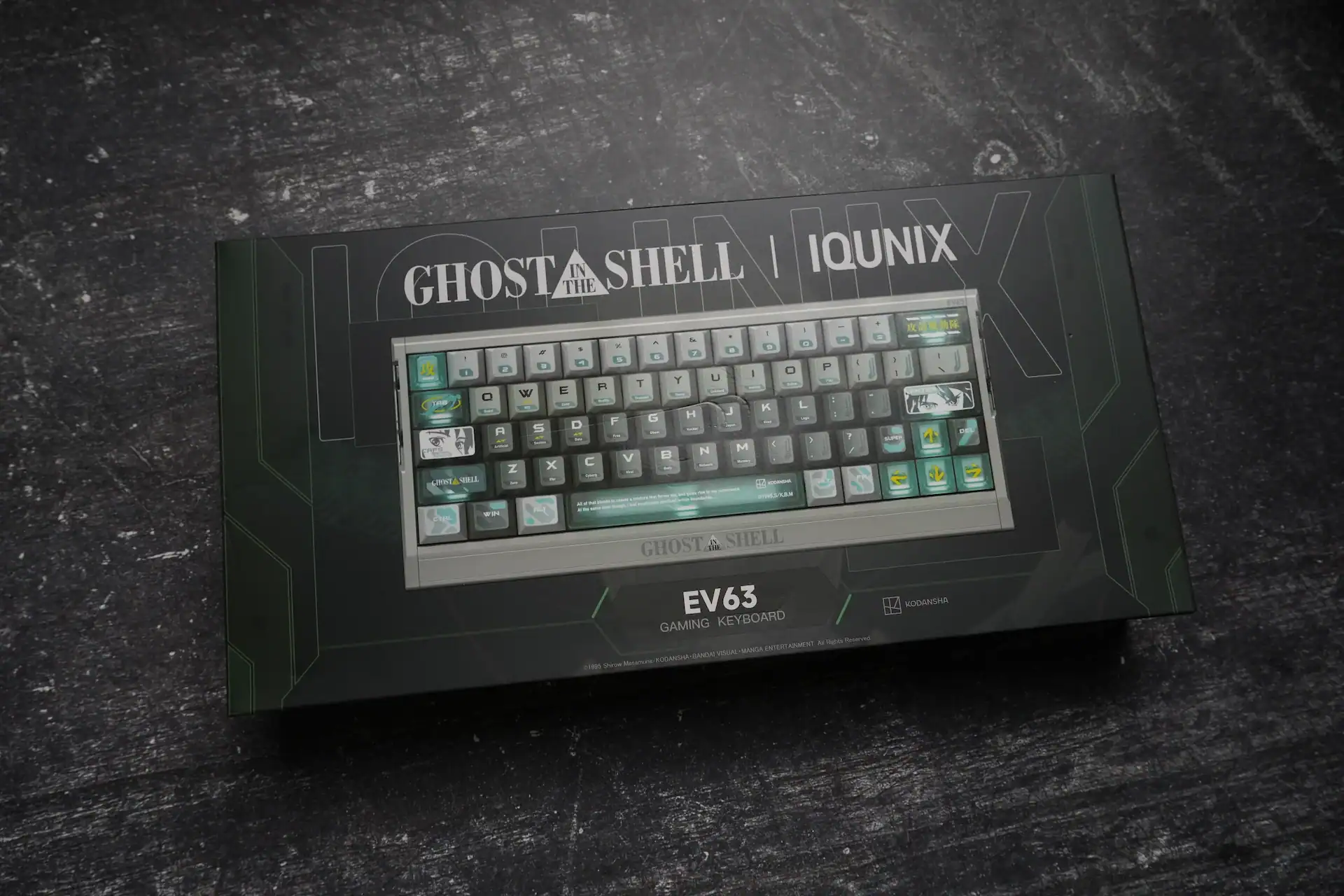
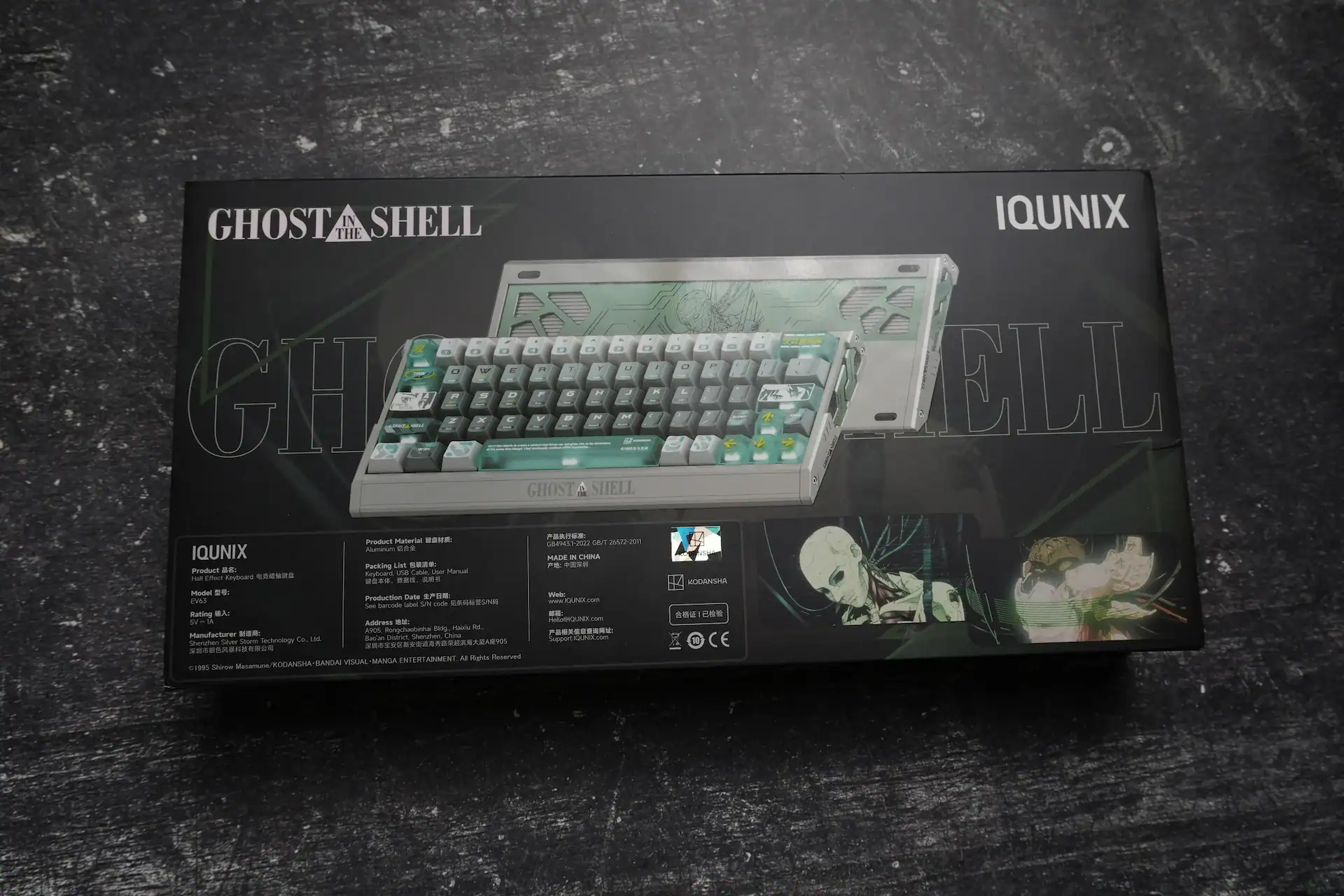
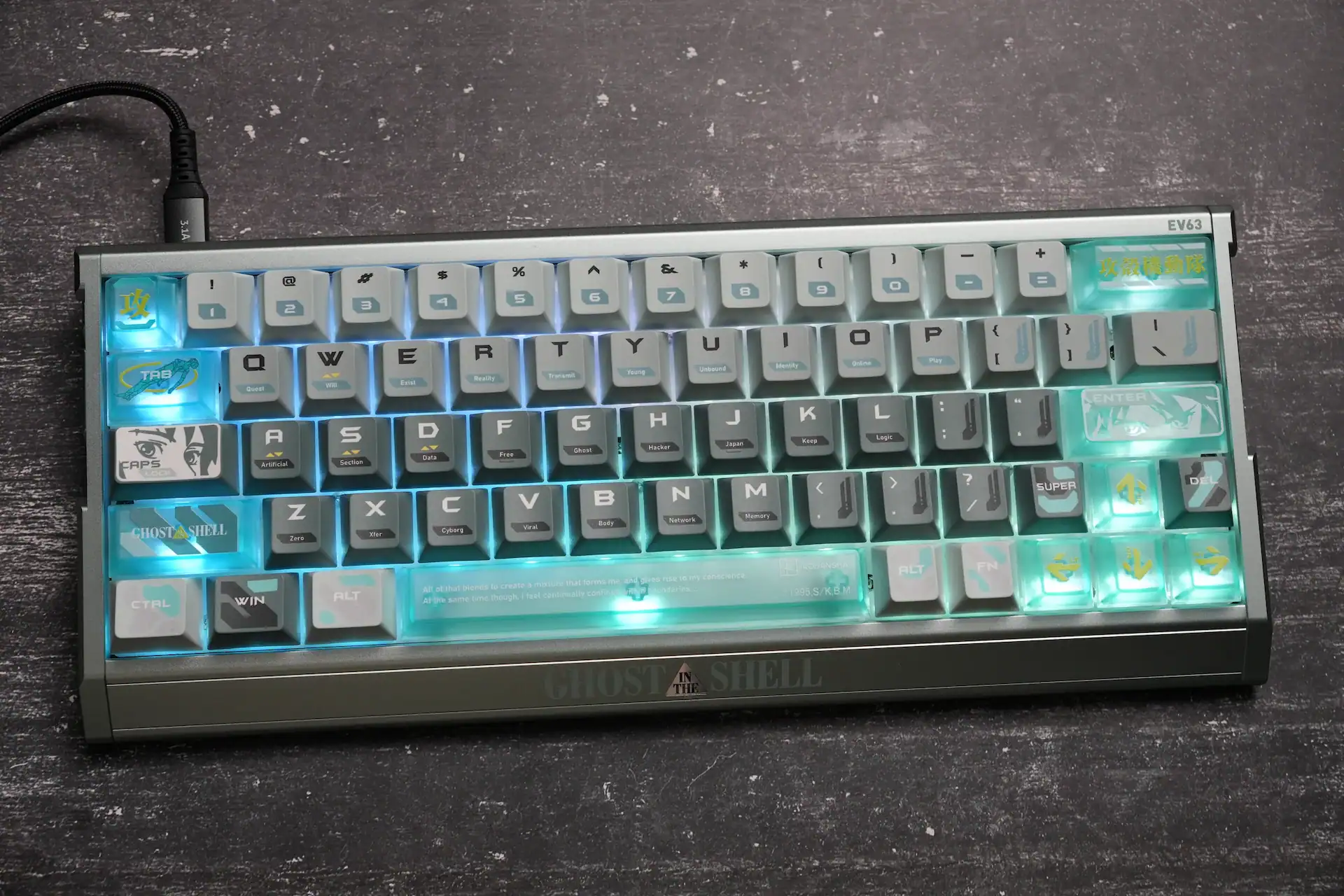
This is the IQUNIX EV63 Ghost in the Shell Edition in the Shell Core color. Our editor Snimtas already published an excellent full review of the standard IQUNIX EV63, so I’d recommend reading that for the complete breakdown of the base platform. What I want to focus on here is what makes this Ghost in the Shell version different — and there are two main things: a distinctly futuristic design, and a different magnetic switch.
There’s no Magnetic X Pro or Magnetic X Ultra to choose from on this edition. Instead, both the Shell Core and Cyber Blue variants ship with the Keytok Nova Switch. This matters more than it might sound, which I’ll get to below.
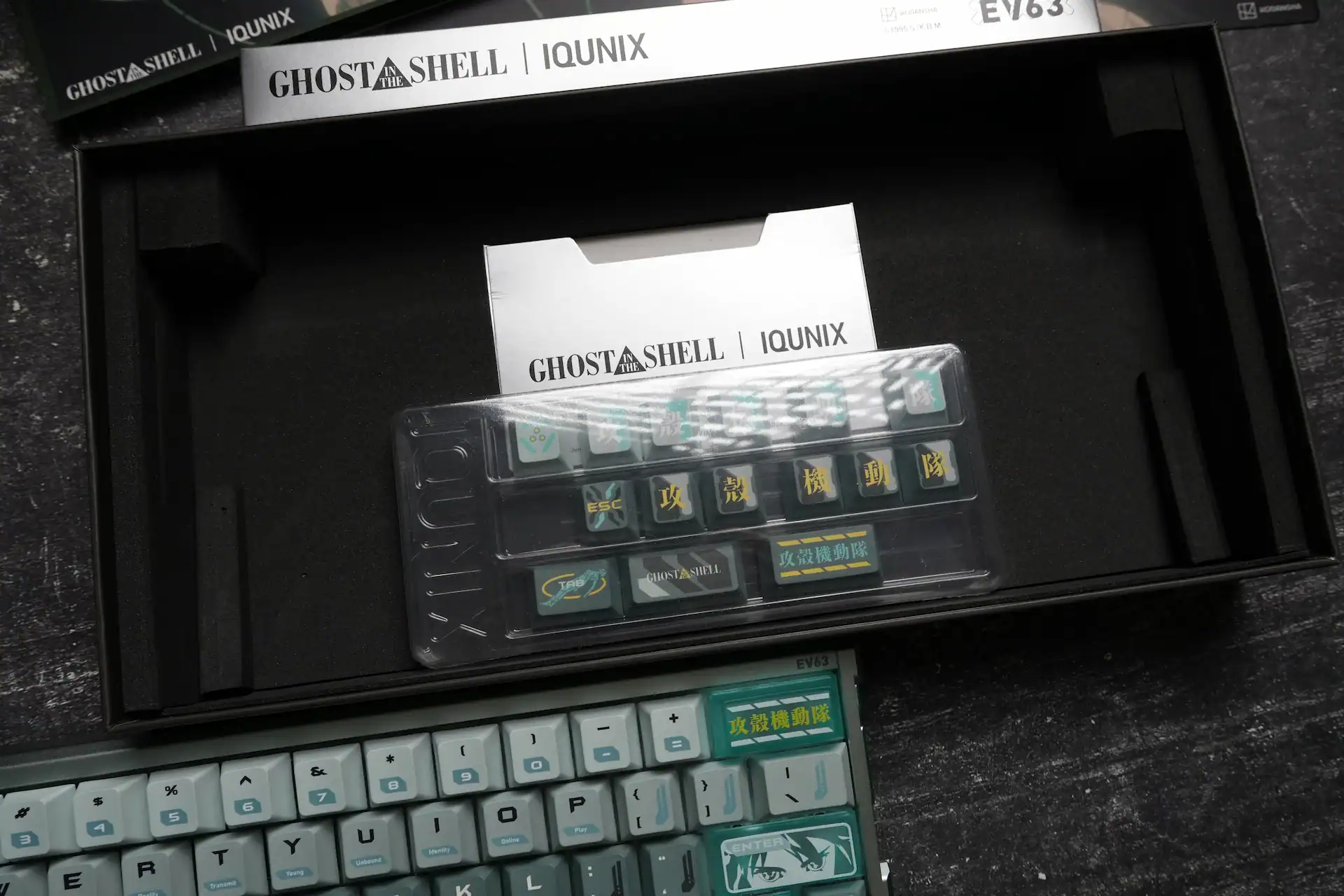
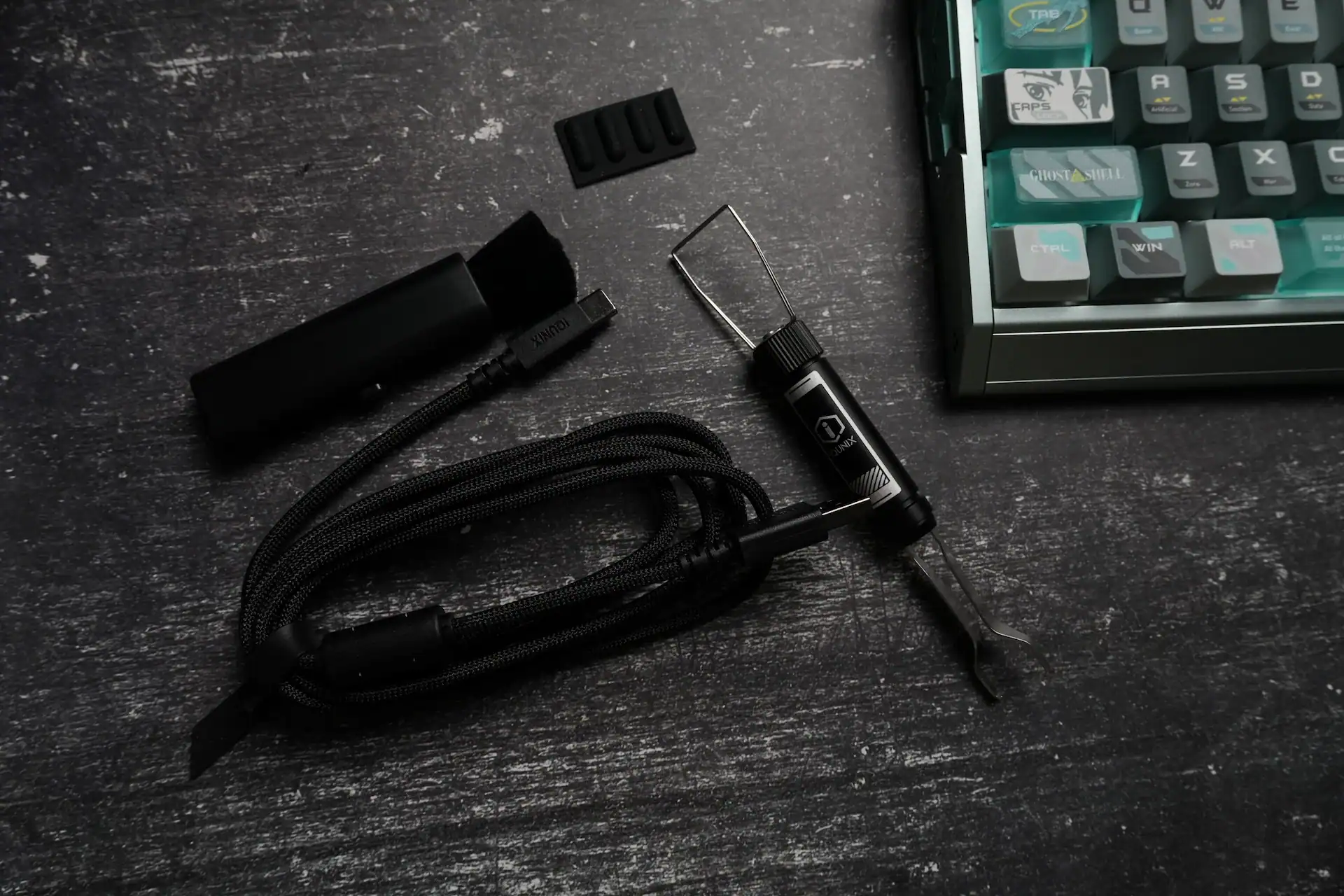
In the box: the keyboard, an L-shaped paracord cable (1.5m), a dust brush, a keycap and switch puller, and a user manual. IQUNIX also includes a set of extra themed keycaps in their own tray — featuring additional 攻殻機動隊 (Ghost in the Shell) Japanese character caps, an alternate ESC, TAB and spacebar, plus novelty accent keys — so you can further customize the look or swap in the kanji legends if you prefer them over the standard alphas.
Design & Aesthetics
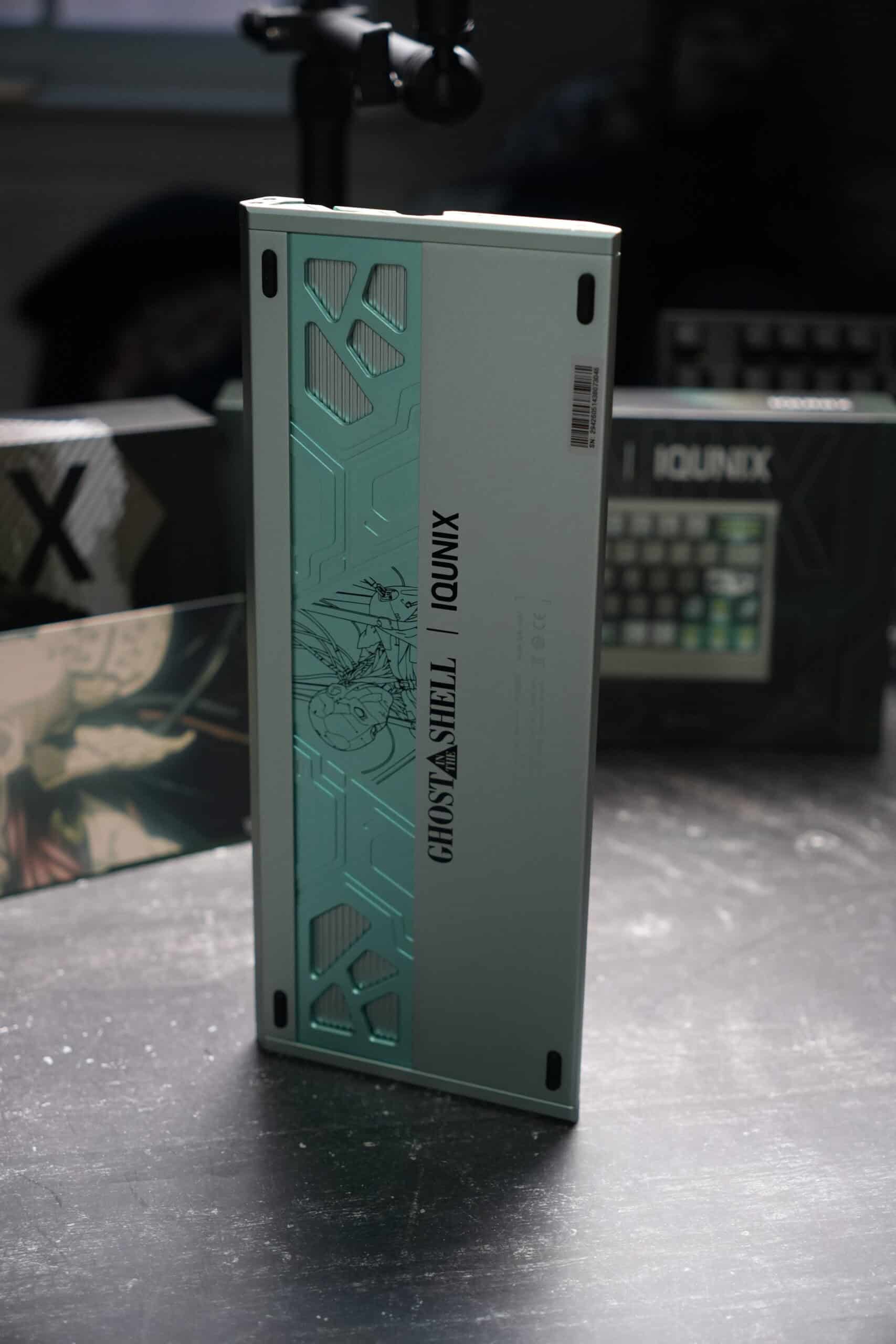
This is where the Ghost in the Shell edition earns its place. The Shell Core uses a silver-grey anodized aluminum case with a PC side accent piece, but the real showpiece is the keycap set. IQUNIX went deep on the theme rather than just slapping a logo on it.

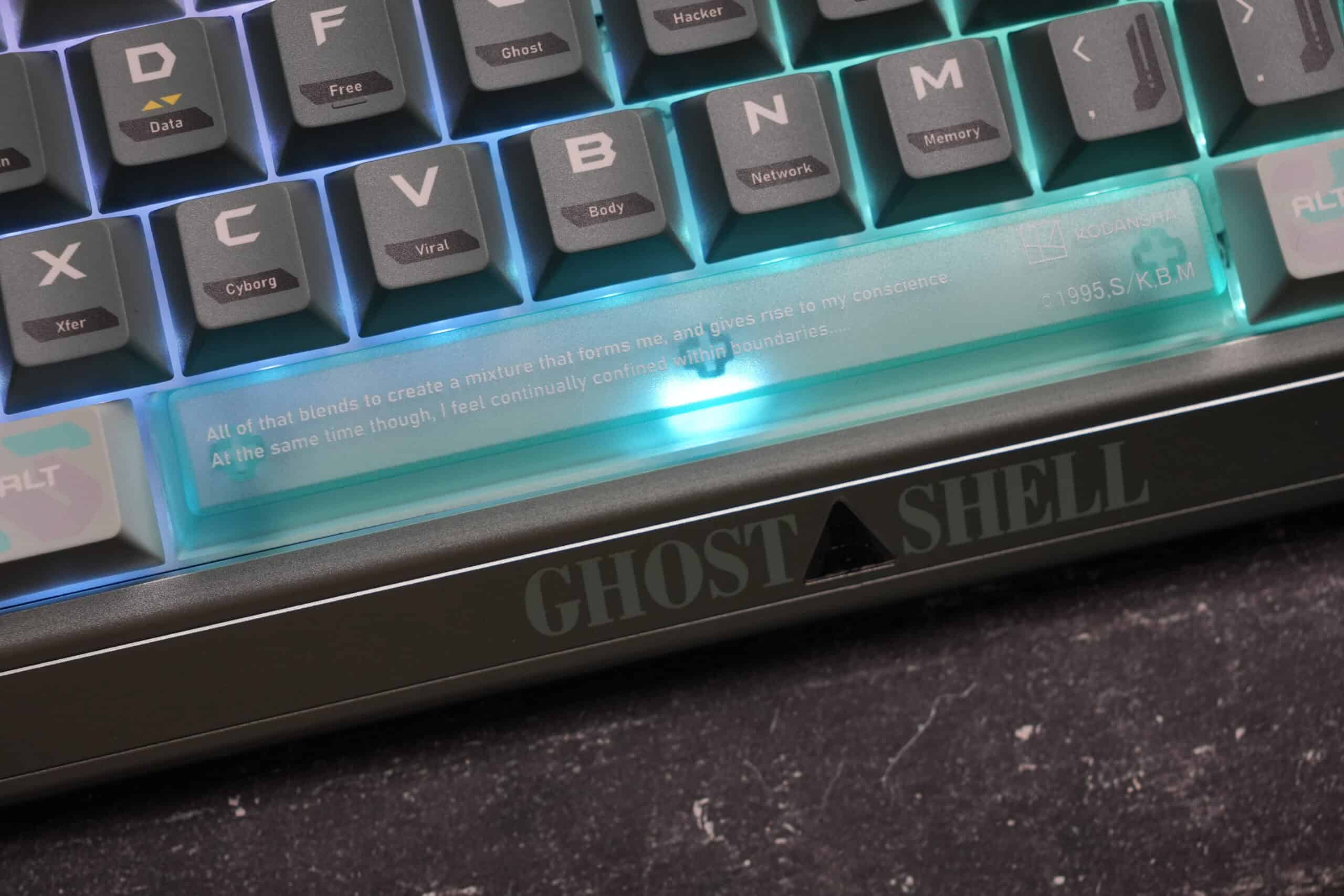
The alphas carry themed sub-legends — Quest, Will, Exist, Reality, Transmit, Young, Unbound, Identity, Ghost, Hacker, Cyborg, Network, Memory, Zero — that read almost like a narrative pulled from the source material. The top-right keys carry the Japanese title 攻殻機動隊, the Enter and Caps Lock keys feature the iconic eye artwork, and there’s a run of translucent teal accent keys across the right side, mod row and arrow cluster. The arrow keys are picked out in yellow. The spacebar carries a printed quote: “All of that blends to create a mixture that forms me, and gives rise to my conscience. At the same time though, I feel continually confined within boundaries.”
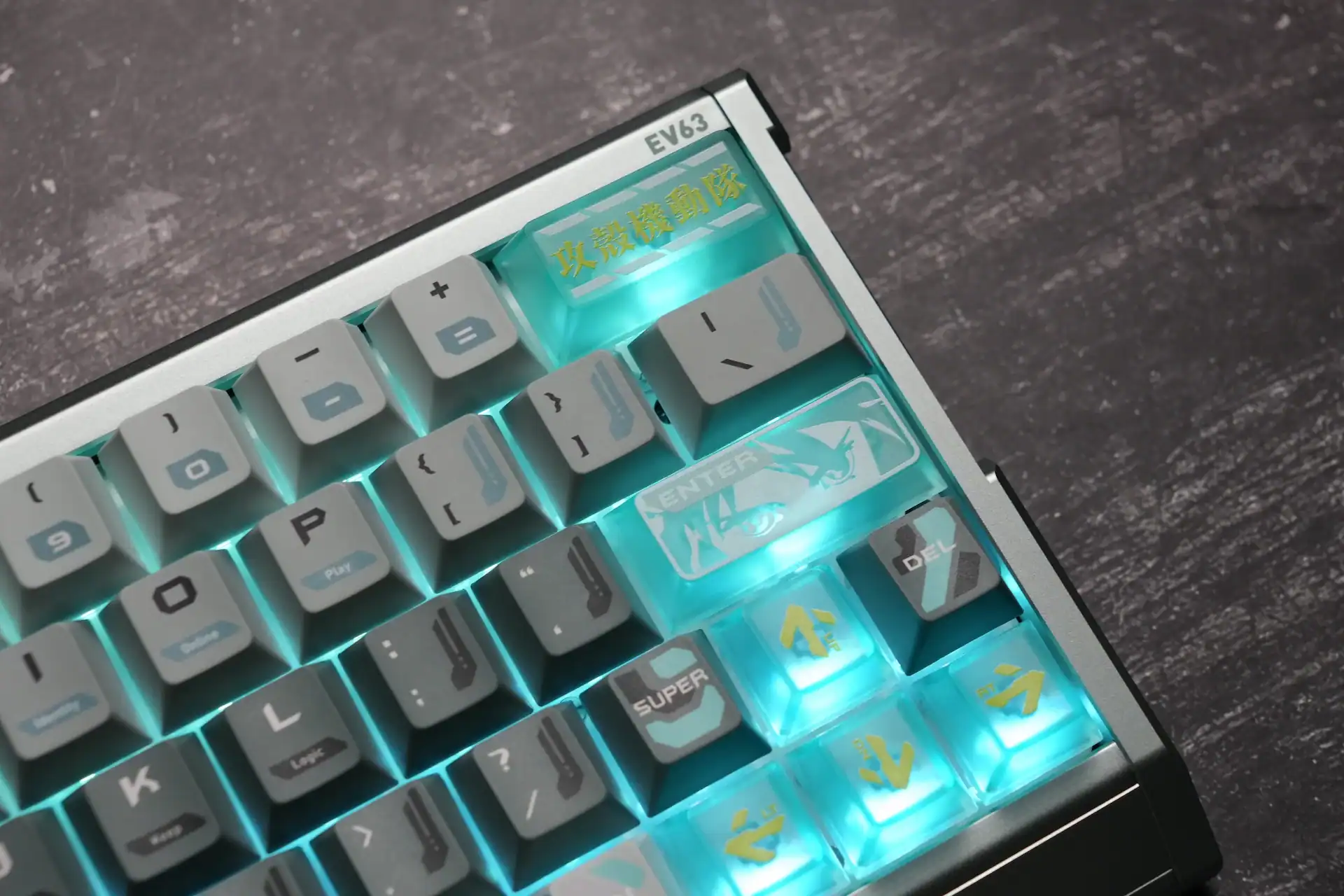
The front bezel is engraved with the GHOST IN THE SHELL wordmark and triangle logo. The per-key RGB shines beautifully through the translucent accent keys — in the angled shots you can see the teal and blue glow pooling through the clear caps and the yellow arrows. The whole package, including the matching themed deskmat, makes this feel like a genuine collector’s piece rather than a sticker-pack reskin.
It’s a subjective thing, but this is one of the more tasteful licensed keyboard designs I’ve handled. If you’re a fan of the franchise, the design alone may justify the purchase.
Specifications
| Layout | 60% · 64 keys |
| Edition variants | Shell Core / Cyber Blue |
| Structure | Gasket mount |
| Case material | Aluminum (Shell Core adds a PC side accent piece) |
| Craft | CNC, anodized |
| Switch | Keytok Nova |
| Keycaps | PBT / PC |
| Polling rate | 8,000 Hz |
| Scan rate | 16,000 Hz |
| Latency | 0.125ms (rated) / 0.7ms (measured) |
| Rapid Trigger | 0.01mm |
| RT sensitivity | 0.01mm |
| Adjustable actuation | 0.01 – 3.1mm |
| Accuracy | 0.01mm |
| Hot-swappable | Yes |
| N-Key Rollover | Yes |
| Per-key RGB | Yes |
| Connectivity | USB Type-C, wired only |
| Software | Web-based |
| Compatibility | Windows, macOS |
| Dimensions | 300.9 × 126 × 18.6mm (front height) |
| Weight | 1,206g spec / 1,188g measured |
| Warranty | 1 year |
| Price | $249.99 |
Keytok Nova Switches
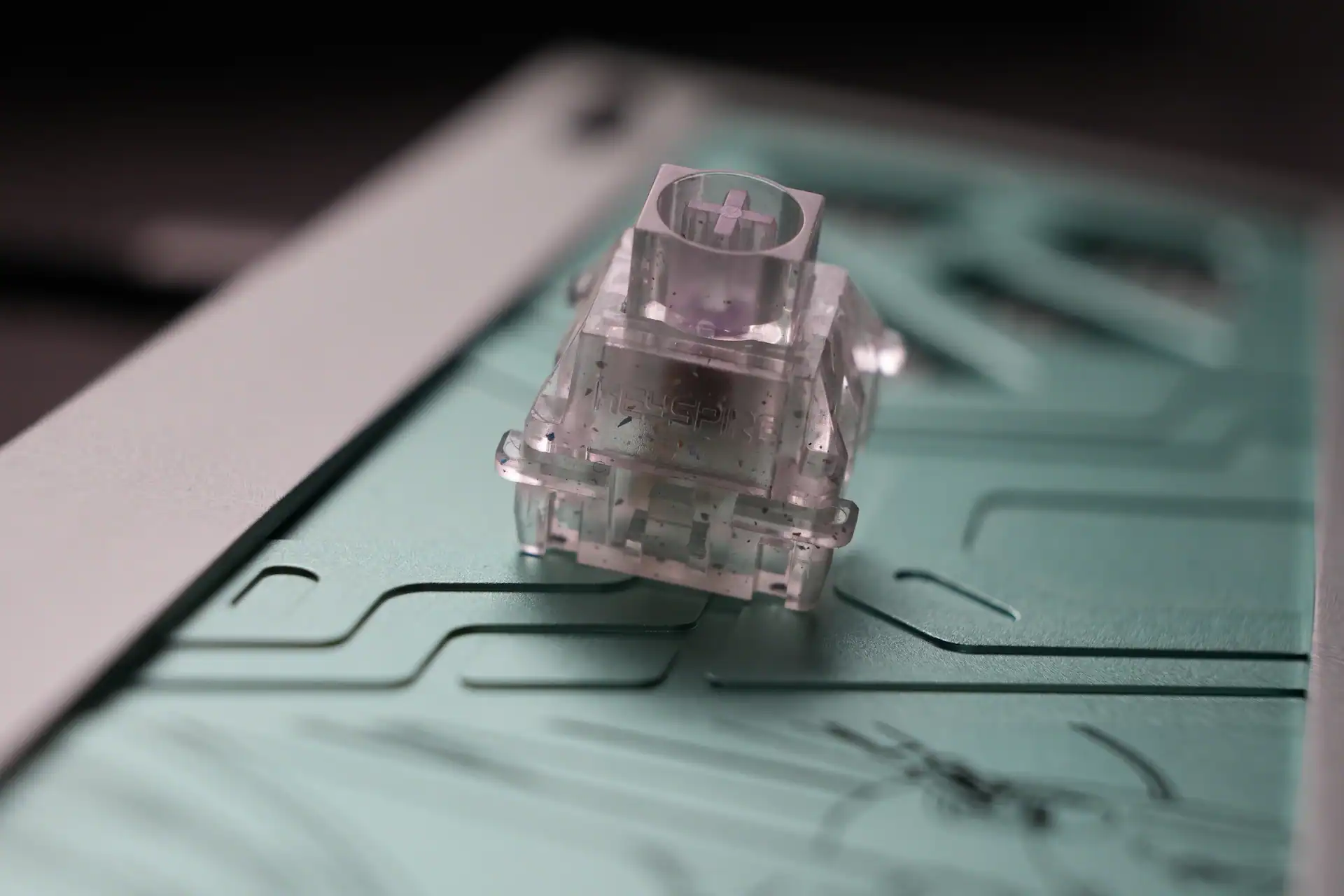
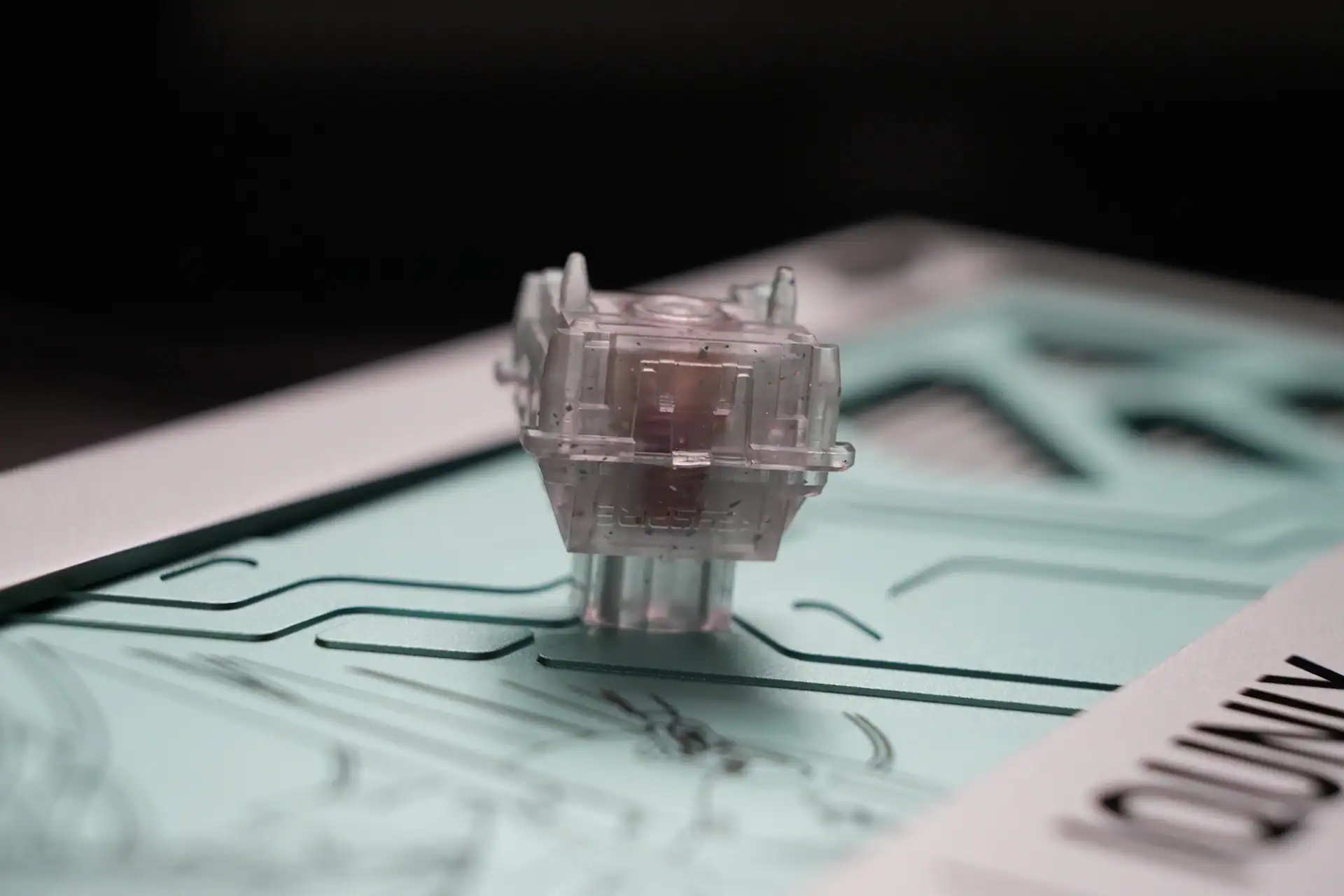
The Nova switch is the headline change on this edition and a genuine selling point. These are linear switches that have become very popular lately among the enthusiast community, and they’re available standalone from Keytok — which means you’re getting a switch with a known reputation rather than a proprietary unknown. The fully transparent housing also looks superb under the per-key RGB, as you can see in the close-up.
Keytok Nova Switch Specs
| Type | Linear |
| Total travel | 3.4 ± 0.5mm |
| Operating force | 35 ± 5gf |
| End force | 48 ± 5gf |
| Stem | PA12 |
| Top housing | PC |
| Magnet sleeve | POM |
| Bottom housing | PA12 |
| Spring | 21mm single-stage gold-plated |
| Factory lube | Yes — spring and slider rail |
| Light transmission | High optical transmittance |
The factory lube on both the spring and slider rail means these feel smooth out of the box without any tuning, and the high optical transmittance lets the per-key RGB shine through cleanly. At 35gf operating force they’re on the lighter side, which suits both gaming and extended typing sessions.
Build Quality
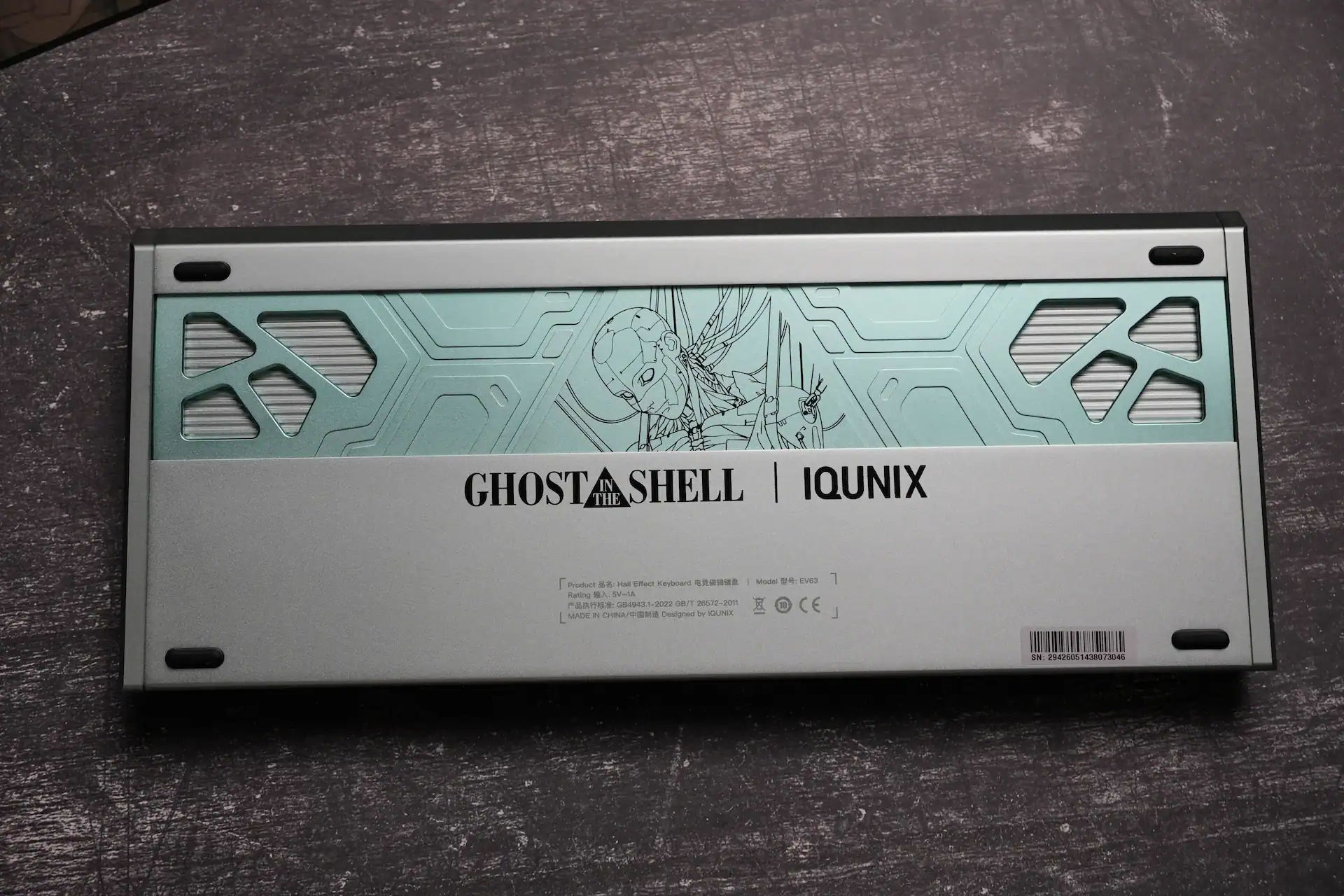
This is where IQUNIX consistently delivers. The Shell Core uses a full CNC aluminum case with a gasket-mount structure. My scale measured 1,188g, slightly under the official 1,206g spec — still a substantial, planted keyboard that won’t shift on the desk.
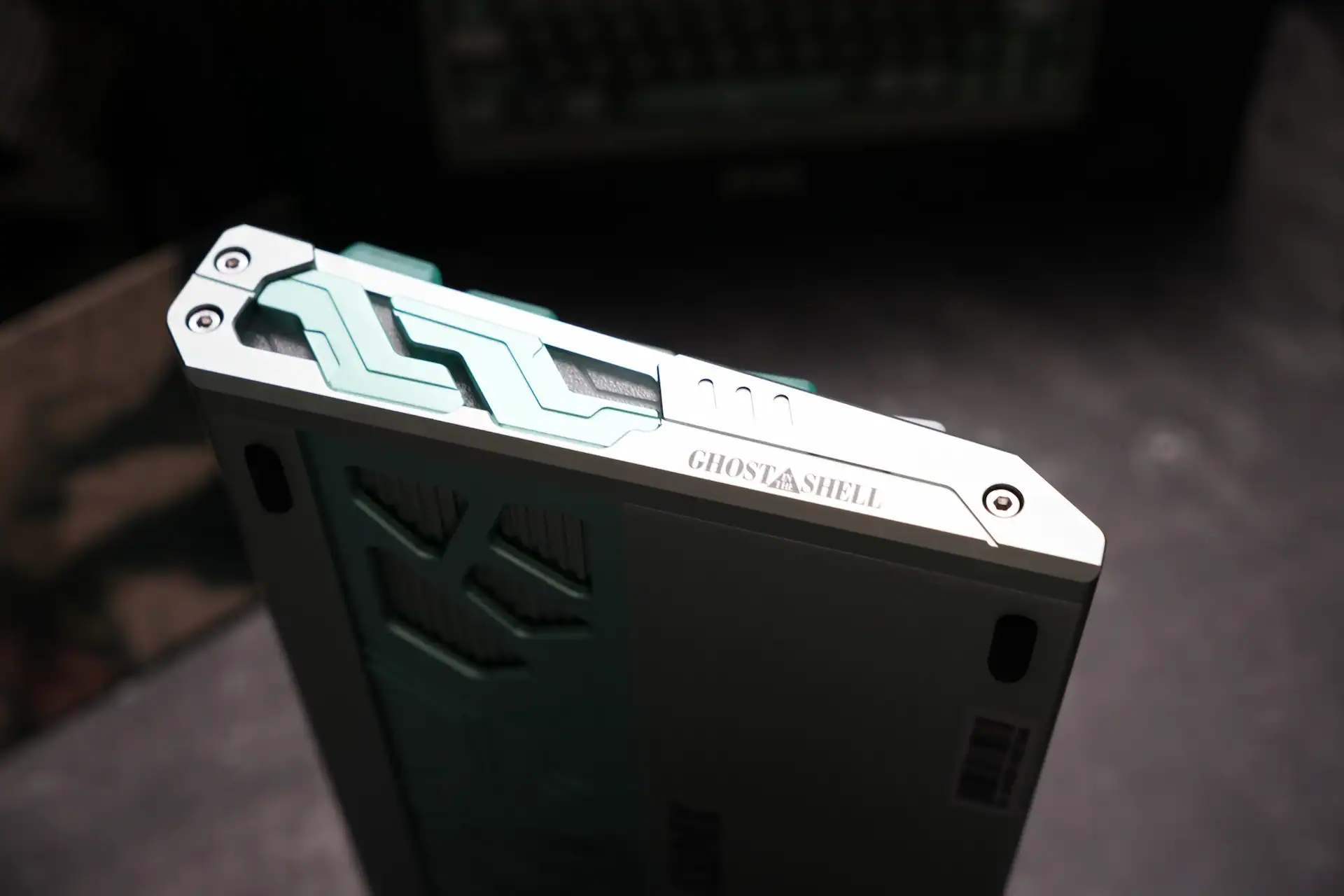
The typing acoustics and key feel are excellent straight out of the box. This is the area where IQUNIX’s HE keyboards earn their reputation: solid, well-dampened, with carefully tuned stabilizers and none of the hollow resonance that plagues many aluminum cases. You do not need to mod this keyboard to make it sound or feel good. The silver carbon fiber plate visible in the switch close-up is part of that equation.
HyperCore V3 Firmware
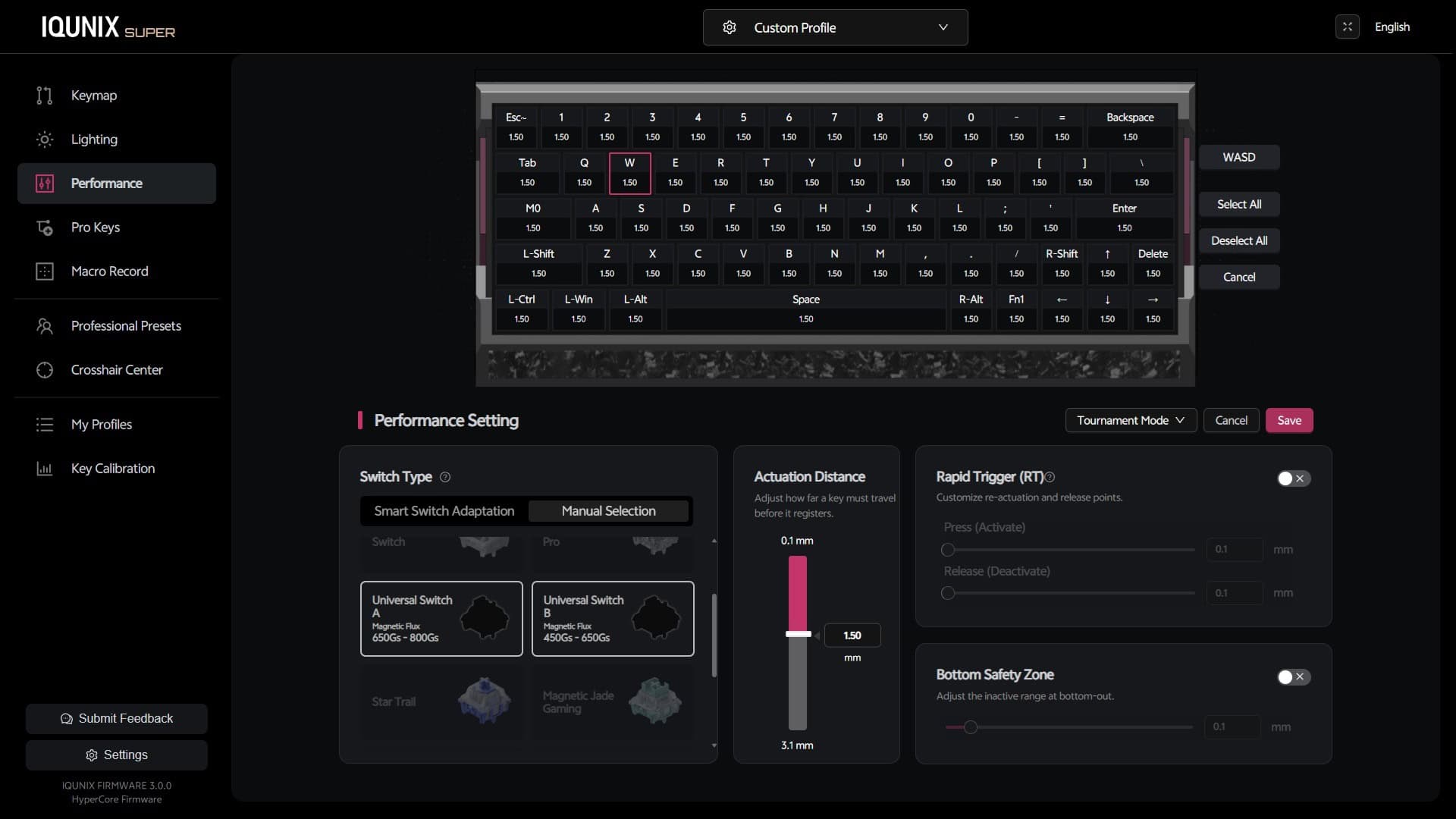
One of the most significant recent developments for the EV63 line is HyperCore V3 — the latest firmware update, which IQUNIX has rebuilt from the ground up. It applies to both the standard EV63 and the Shell Core and Cyber Blue editions.
The stated goals are practical rather than benchmark-chasing: make every keypress fast, keep performance stable across sessions, ensure predictable behavior during competitive play, and enable effortless switch adaptation without sacrificing accuracy. IQUNIX frames it around what players actually feel in-game rather than raw numbers (more detail here).
What’s actually in it:
- Intelligent Calibration — real-time dynamic calibration keeps triggers consistent during extended use
- Rebuilt filter & temperature compensation — reduces noise and improves long-term actuation stability
- RT accuracy optimization — more precise, stable response under high-speed input
- Signal chain optimization — improved USB scan and desync handling for smoother input
- Power & architecture upgrades — better boot, sleep/wake and power stability
- Storage & framework upgrade — faster read/write and configuration handling
- EDG Competitive Mode — a pro-tuned profile, plus resolution adaptation, settings preservation across updates, and over 100 UI improvements
A notable point IQUNIX makes about its architecture: they compare the EV63 to Apple designing both chip and OS together, versus other keyboards using off-the-shelf components. Their argument is that more MCUs don’t automatically mean better performance — what matters is system architecture, scan strategy, communication pipeline and scheduling. The result, per IQUNIX, is that a single-MCU EV63 can achieve lower latency than many multi-MCU keyboards. That’s a manufacturer claim, but our latency testing (below) supports the keyboard performing at the top tier regardless of the explanation.
Smart Switch Adaptation
This deserves a callout because it’s genuinely useful for a hot-swappable HE board. Hall Effect switches detect position based on the magnet-to-sensor distance, and different switches vary in magnet strength, mold structure and magnetic curve. If the keyboard’s recognition curve doesn’t match the installed switch, you can get accuracy errors, missed or false keypresses, and inconsistent triggering.
Traditionally, each switch needed manual profile selection. IQUNIX’s Smart Switch Adaptation handles this automatically — after a single calibration, the keyboard recognizes and matches the new switch’s magnetic curve. For anyone planning to experiment with different magnetic switches, this removes a real friction point.
Latency
Tested with OSLTT (OS Latency Testing Tool), measuring the time between keycap contact and signal receipt by the computer.
| Connection | Latency |
|---|---|
| Wired | 0.70 ms |
This ranks the EV63 Shell Core among the lowest-latency keyboards in our database. It’s an excellent result — well below the threshold where any human could perceive a difference.
How It Compares — Within the EV63 Series
The Shell Core and Cyber Blue editions share the same core platform as the standard EV63 lineup (Violet, Dark Knight, Silver Knight), so the performance figures — 8K polling, 16K scan rate, 0.01mm RT — are consistent across the family. The meaningful differences on the Ghost in the Shell editions are the design treatment and the Keytok Nova switch in place of the Magnetic X options. If you want the standard switch choices, the regular EV63 variants are the route; if you want the distinctive aesthetic and the popular Nova switch, this is the one.
How It Compares — IQUNIX vs Wooting
Since the EV63 series is a strong representative of IQUNIX’s Hall Effect lineup, it’s worth a fair comparison with Wooting 60HE v2, the other major name in HE keyboards.
Build quality goes to IQUNIX. A common criticism of Wooting’s stock boards is a plasticky feel and a hollow, scratchy sound, which often pushes users toward aftermarket aluminum cases and mods. IQUNIX’s EV/EZ series ships with a full CNC aluminum chassis, gasket mount and proper sound dampening out of the box — no modding required. For hybrid users who want one board for both typing and competitive gaming, that’s a real advantage.
Core performance is essentially a tie. Both are sub-1ms latency keyboards with 8,000Hz polling and sub-millisecond Rapid Trigger — we measured both below 1ms in our own testing, which is more than good enough. At these levels you’re well past the point of diminishing returns, where any remaining differences are imperceptible in actual gameplay like Valorant or Apex. On features, IQUNIX has closed the gap too: competitive features like SOCD / Snap Tap have been rolled out via firmware updates.
The honest summary: both are top-tier sub-1ms performers, so the decision comes down to feel and finish rather than speed. If you want endgame build quality, acoustics and feel without buying mods, IQUNIX is the stronger out-of-the-box package.
Verdict

The IQUNIX EV63 Ghost in the Shell Edition (Shell Core) is one of the best-built and best-looking Hall Effect keyboards you can buy without reaching for aftermarket mods. The full aluminum gasket-mount case, the globally popular Keytok Nova switches, top-tier 0.7ms measured latency, and the substantial HyperCore V3 firmware overhaul together make a compelling package. Smart Switch Adaptation is a genuinely useful feature for a hot-swap HE board, and the themed keycaps elevate it from a performance tool into something you’ll want on display.
The trade-offs are straightforward: it’s wired only, it’s a 60% layout so you lose a dedicated arrow row and function row, and there’s no Magnetic X switch option on this edition. The web-only software is fine but some users prefer a desktop driver.
- One of the best-executed collab keycap sets I’ve seen
- Full CNC aluminum case with gasket-mount
- Smooth Keytok Nova switches
- 0.7ms measured latency
- Very good web app with lots of features
- Wired only
- Premium price positioning
If you want a premium HE keyboard with standout design and don’t need wireless or a larger layout, this is an easy recommendation — and one of the best-feeling and best-looking boards in the category out of the box.
Buy it here: IQUNIX EV63 Ghost in the Shell Edition — use code HLPLANET to save 5%.
More IQUNIX reviews:
IQUNIX EV63 Ghost in the Shell Edition


I love testing and writing about new tech. I focus on keyboards and controllers. I'm also a gamer and an engineer. Check out my Twitter for keyboard and controller news and reviews.